TopxAI
Opening page
Opening page
Loading product details
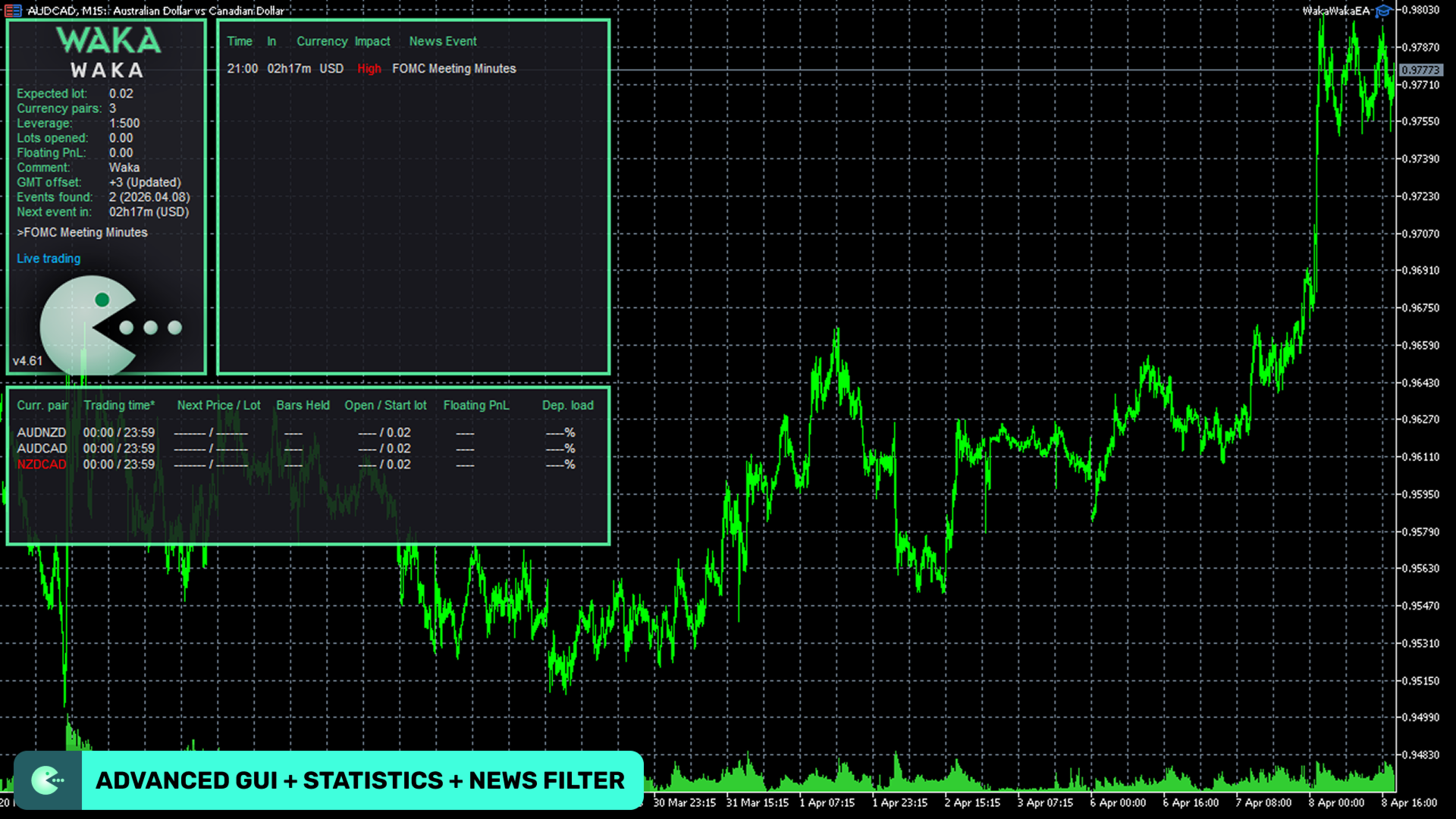
Smart grid · multi-pair evergreen
Waka Waka EA (MT5) by Valeriia Mishchenko is an automated grid-and-recovery system with a multi-year real-money track record, designed to exploit recurring short-term price inefficiencies.
It trades a mean-reversion grid: it opens positions when price stretches away from its average and adds averaging orders at volatility-adjusted distances, aiming to close baskets in profit as price reverts. Entries are filtered with Bollinger Bands and RSI; lot progression follows a configurable martingale-style logic.
Single-chart setup that manages all symbols at once
Multiple lot-sizing modes (fixed, dynamic, deposit-load, or preset risk)
Built-in maximum drawdown protection
News and holiday filters
Volatility-adaptive grid spacing
Symbols: AUDCAD, AUDNZD, NZDCAD
Timeframe: M15
Account: hedging account with continuous VPS operation
Risk note: grid and martingale systems carry significant risk; a losing basket can grow quickly. Use conservative sizing and adequate capital.
BinanceGrid is TopXEA's own MT5 EA for Binance USD-M futures on HYPE, LIT and ADA. This review covers how it trades, where the risk sits, how to read the backtest and who should not run it.
Waka Waka is a long-standing AUD-cross martingale grid that's frank about its mechanism. A professional take on why its high-return story must be read with the 50-72% drawdown.
We read every line of Quantum King 3.1's MQL5 source and compiled it. No licence checks, no trial timer, no hardcoded date tables — which is rarer than it should be. But it attaches no stop loss by default and every account-level guard ships disabled. Here's the mechanism and the boundaries.
Perceptrader AI uses a neural network to filter signals, but underneath it is still a grid. What makes it unusual is the live record: 173 weeks, +341.04%, 6,602 trades, 17.06% max drawdown. Here's the real structure, how to read that record, and whether you can live with grid risk.